


- The Zero Trust fitness score is built on CMMI’s five levels, not on a new vendor model.
- Every criterion is binary: no partial credit and no weighting, so the same data always gives the same score.
- Levels are cumulative, and a stale readiness assessment blocks level 3 and everything above it.
- The score can go down, which is what makes the trend line worth looking at.
In my previous blog post I wrote that measuring security is hard, but measuring Zero Trust isn’t. That post was about two dimensions which together form a quadrant, and about one thing above all: if you want to do Zero Trust well, the business and the operation have to be aligned. Strategic and operational, pointing the same way. Without that, the rest does not happen.
This post is about the other axis. Once Zero Trust is operationalized, how do you measure it? That is what we call Zero Trust fitness, and the Zero Trust fitness score tells you, at any moment of any day, where you stand.
We did not want to invent a new maturity model
The last thing this industry needs is another vendor with its own five-level model. So we did not build one. We took CMMI, which has been around for decades and is widely understood well beyond security, and used it as the basis.
CMMI has five levels. You cannot go below 1 and you cannot go above 5. Every organization starts at level 1. An organization that has done nothing at all is at 1, not at 0.
The work was in deciding what each level should mean for Zero Trust. We did that by discussing it with customers, arguing about it internally, reading what others had published and building on the work John Kindervag had already done in this space.
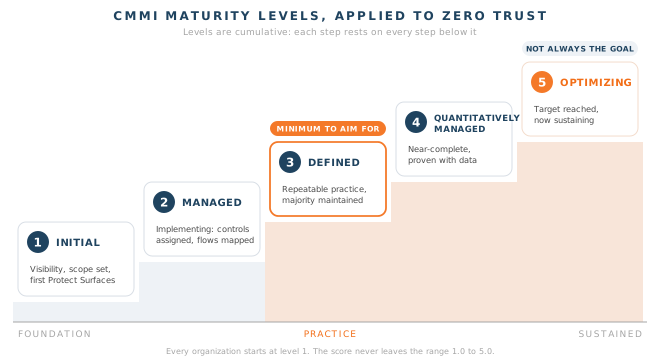
This is roughly what each level holds:
Level 1, Initial.
You have started. Your existing network segments are onboarded so you can see your environment, you have set a target, you know who owns what, and the first real Protect Surfaces are defined. This level is about visibility and getting the foundation under the measurement.
Level 2, Managed.
Zero Trust is actively being implemented. A meaningful part of your environment is defined and in focus, controls are being assigned, transaction flows are being mapped. You are building operational discipline.
Level 3, Defined.
Zero Trust is no longer a project, it is part of how the organization works. The majority of Protect Surfaces are defined and actively maintained, metadata is complete, and the readiness assessment happens on a regular cadence. This is a solid, repeatable Zero Trust practice.
Level 4, Quantitatively Managed.
Zero Trust covers nearly your whole environment. The vast majority of Protect Surfaces are implemented, evidenced and monitored. You can demonstrate your security posture with data rather than with opinions, and the remaining gaps are known and justified.
Level 5, Optimizing.
You have reached the target you set. Everything in scope is implemented and maintained, and the focus shifts from building to sustaining.
Which level should you aim for?
Not necessarily level 5. The right level depends on your ambition, your risk appetite and the industry you are in. If you find yourself pushing every Protect Surface toward 5, that usually means you have not decided what matters most.
Signal
There is a floor though. Any organization that is serious about Zero Trust should be at least at level 3. Below 3, Zero Trust is still an initiative that can be cancelled. From 3 onwards it is how you operate.
Why the score has to be deterministic
If you want to measure something and especially if you want to know whether you are making progress or declining, the score has to be trustworthy. By that I mean deterministic: the same data has to produce the same score, every time.
So for every maturity level we wrote down criteria that can only come out true or false. Boolean. Either you meet it or you don’t.
That sounds obvious, but it rules out the two things that quietly ruin most security scores.
Ruled out: partial credit
The first is partial credit. A criterion that asks for 60% coverage passes at 60% and fails at 59%. At 59% it contributes exactly what 0% contributes, which is nothing. That feels harsh, and it is deliberate. The moment you start awarding partial credit, the score starts negotiating with itself.
Ruled out: weighting
The second is weighting. There isn’t any. Nothing counts for more than anything else, because a weight is an opinion and an opinion can be argued. There is no formula with knobs on it, so there is nothing to turn up before a board meeting.
What you get back is a number anyone can reproduce. Hand the same snapshot to our platform or to someone with a spreadsheet and a few minutes, and you get the same answer.
How the number is built
The score is a level plus a decimal, and the decimal is what makes it useful month to month instead of in five enormous jumps.
The whole number is the level you are currently completing, not the one you finished. The decimal is the share of that level’s own criteria that currently pass.
Example
An example. Suppose all of level 1 passes and all of level 2 passes. Level 3 has six criteria and three of them pass. You are working through level 3, you are halfway through it, so your score is 3 + 3/6 = 3.5.
The score always stays between 1.0 and 5.0. Once every level 5 criterion passes as well, it tops out at 5.0.
The other thing we built in is that the levels are cumulative. A lot of what Zero Trust asks for at the start is basic and has to be in place before anything above it means much. So a level only counts once that level and every level below it are complete.
That has a consequence worth being explicit about. If everything is green up to level 3 but one level 1 criterion is failing, you are not at 3. You are back at level 1, because the foundation the higher levels were resting on is not there anymore. Not 2.9. Level 1.
There is one criterion that behaves as a hard gate. The readiness assessment has to be current, and that is one of level 3’s own criteria. Let it go stale and level 3 can never complete, which blocks level 4 and level 5 as well, no matter how good your operations look.
That is not an accident. It is the message of the first blog post, wired into the scoring. We are not just advising that alignment matters. The model refuses to award maturity to an organization that stopped checking whether its business is still behind this.
Most Zero Trust programs don’t fail on technology. They fail on alignment.
Binary criteria have one more advantage that matters a lot once this lands on a CISO’s desk: the gaps name themselves. A report never just says 3.5. It says 3.5, and level 3 is being held open by two criteria: not enough Protect Surfaces fully implemented and not enough transaction flows mapped. That is not a score to discuss, it is next quarter’s plan.
What we measure
Every criterion has to be measurable from real data or from a documented assessment. If we cannot measure it, it does not become a criterion. These are the components:
Protect Surface coverage
How well do you know your environment and how much of it is actually covered by Zero Trust?
Metadata completeness
You know what you want to protect, but do you know who is responsible for it, what data sits in it, how important it is to the business and which compliance frameworks apply? And is that information still true today?
Transaction flow coverage
Step 2 of the five steps. Do you know how everything is interconnected? And if an attacker does get in, how far can they reach? What is the blast radius?
Control assignment
Do you know which controls each Protect Surface needs? This differs per Protect Surface. A guest network needs different controls than your internal clients or your CRM system.
Implementation completeness
You have assigned the controls. How many of them have you actually implemented?
Up-to-date readiness assessment
Misalignment between the strategic and operational sides is the biggest cause of failed Zero Trust implementations, so this one has to be up to date, with everyone involved and everyone aware that we are doing this.
One number that is not static: the scoping target
Almost everything above is measured statically. The scoping target is the exception, and it is the denominator for all the coverage percentages: the number of Protect Surfaces you expect to end up with.
It is a moving target on purpose. The more you work in your environment the more you learn about it, and the more Protect Surfaces emerge that nobody had thought of. Early on this number is close to a guess, and we can help you with it because we have seen a lot of environments across a lot of industries. The further you get, the more precise it becomes.
The important part is not that the number is right on day one. It is that a number exists, because without it there is nothing to divide by and no coverage percentage to report.
A score that cannot fall is not a score worth having
Most maturity scores are a ratchet. You get certified once and you are that level forever. That is a marketing number, not a measurement.
Ours goes down and it should. If you stop maintaining step 5, your Zero Trust decays. You implemented a handful of Protect Surfaces and attached the business owners to them, then those owners leave the company. The data is no longer valid and something needs to be done about it. Your score drops and tells you so.
That is also what makes the trend line worth looking at. Because the scoring is deterministic, every snapshot is comparable with every other one.
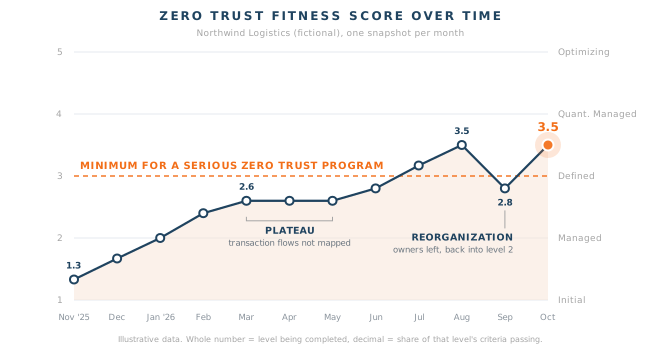
This is a fictional organization, but every shape in that line is one we see in real environments.
The first five months are the climb, from 1.3 to 2.6. Onboarding, the first Protect Surfaces, metadata, controls. Early progress is fast because the first criteria are the most basic ones.
Then it goes flat for two months. Nothing went backwards, but nothing went forward either. The transaction flows were not being mapped, and until they are, level 2 cannot complete. A flat line is a finding in its own right and without history you would never see it.
In August the organization reached 3.5. In September a reorganization took several business owners out of the company, metadata completeness dropped below the level 2 threshold, and the score fell back to 2.8. All the level 3 work was still there. It just could not be credited while the foundation underneath it was broken. Owners were reassigned and the next snapshot was back at 3.5. Same data, same score.
The dashed line is level 3, the minimum for anyone serious about this. This organization crossed it in July, fell below it in September and is back above it today. That is a story you can tell a board in one slide. It is not a graph of how we felt that quarter. It is a graph of what was actually there.
And once that line starts moving, it tends to keep moving. People can see their work landing, which makes the next Protect Surface easier to get through than the last one.
Conclusion
Final signal
A score you can reproduce by hand is a score you can defend in a board meeting. That is the whole case for making it deterministic: it means the trend line, the comparison with last quarter and the number you put in front of your board all hold up when someone pushes on them.
And you still need both angles. The fitness score tells you how mature your Zero Trust actually is. The readiness assessment tells you whether the business is behind it. The first post covered that one separately on purpose, because that is where we see most organizations fail.
Related reading
- Measuring security is hard. Measuring Zero Trust isn’t.
- Zero Trust isn’t hard
- Navigating Zero Trust, part 1
- The crucial role of business alignment in Zero Trust
- You don’t need additional AI security tooling
Get in touch
Curious where you would land?
Reach out and we will walk through it with you.
Reach outFAQ
How is the Zero Trust fitness score built?
The score is a level plus a decimal. The whole number is the level you are currently completing, and the decimal is the share of that level’s own criteria that currently pass. If all of levels 1 and 2 pass and three of level 3’s six criteria pass, the score is 3 + 3/6 = 3.5.
Why is the score based on CMMI?
Because the industry does not need another vendor with its own five-level model. CMMI has been around for decades and is widely understood well beyond security. ON2IT used it as the basis and decided what each of its five levels should mean for Zero Trust, together with customers and building on the work of John Kindervag.
Which Zero Trust maturity level should you aim for?
Not necessarily level 5. The right level depends on your ambition, your risk appetite and your industry. There is a floor though: any organization that is serious about Zero Trust should be at least at level 3. Below 3, Zero Trust is still an initiative that can be cancelled. From 3 onwards it is how you operate.
Why is there no partial credit or weighting?
Because the score has to be deterministic: the same data must produce the same score every time. Every criterion is either met or not. Partial credit lets the score negotiate with itself, and a weight is an opinion that can be argued. Without either, anyone with the same snapshot and a spreadsheet gets the same answer.
Can the Zero Trust fitness score go down?
Yes, and it should. Levels are cumulative, so if a lower-level criterion fails, the higher levels no longer count. When business owners leave and metadata is no longer valid, the score drops. A stale readiness assessment blocks level 3 and everything above it. That is what makes the trend line worth looking at.

Rob Maas is Field CTO at ON2IT, part of the CTO Office under CTO Lieuwe Jan Koning. He works on product strategy and architecture for AUXO, MDR, and ZTaaS, shaping ON2IT's Zero Trust customer journey and AI feature roadmap. He is also a Palo Alto Networks Cyberforce Hero.